
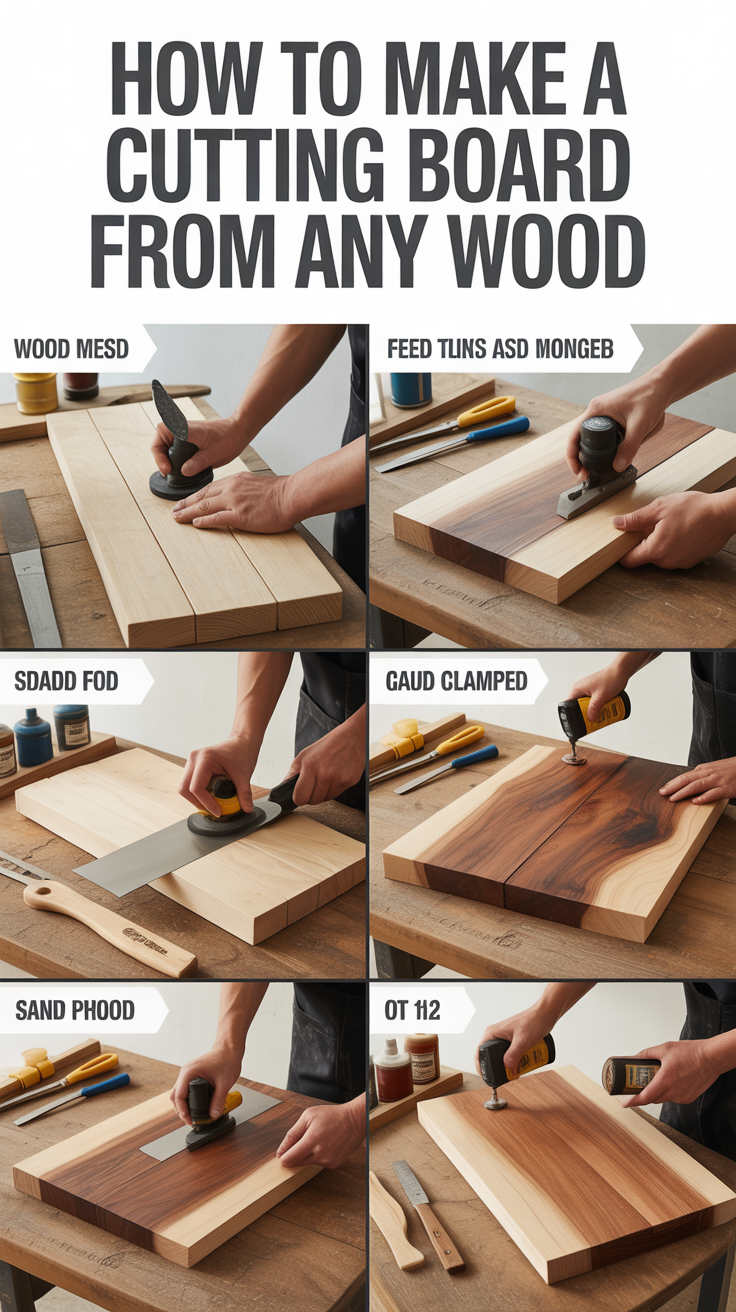
A well-made cutting board is one of the most rewarding beginner-to-intermediate woodworking projects. This step-by-step guide shows you how to make a cutting board from any wood safely and beautifully—covering species selection, milling, glue-up, shaping, food-safe finishing, and long-term care. Whether you choose humble maple or striking walnut and cherry, the process and principles stay the same, so your board looks great and lasts for years.
If you prefer printable plans and measured drawings, check out the comprehensive templates in TedsWoodworking, which include cutting boards and dozens of kitchen projects.
Table of Contents
Foundations for how to make a cutting board from any wood
The key to “any wood” is knowing which woods are appropriate for food contact and how grain, hardness, and porosity influence performance.
- Choose tight-pored hardwoods. Dense, closed-grain species resist absorbing moisture and trapping food particles. Maple (hard/dense), beech, cherry, and walnut are classic choices. Teak and acacia are popular, too, though their natural oils can slightly complicate gluing—use fresh surfaces and a waterproof glue.
- Avoid open-pored and very soft woods. Red oak, ash, and elm have large pores that can harbor moisture and bacteria. Pine and other softwoods dent easily, leading to grooves that trap residue.
- Understand grain orientation.
- Edge-grain boards assemble strips with their edges up: stable, efficient, and a great first project.
- End-grain boards place the ends of the fibers on the surface: gentler on knives and visually striking “checkerboard” patterns, but more time-consuming.
- Face-grain boards are pretty but can move more with humidity; best as serving boards rather than heavy-use workhorses.
- Mind wood toxicity and allergies. Most domestic hardwoods are safe for food-contact surfaces when fully finished and maintained, but some exotics can cause skin reactions in dust form. Consult reliable references before you buy exotic species.
- Target thickness and size. A good all-around board is 1 to 1-1/2 inches thick. A popular size is 12 x 18 inches for countertop use, with 16 x 20 inches for larger prep or carving boards.
Best practice is to use kiln-dried lumber at indoor moisture content, maintain consistent grain directions during glue-up, and finish with proven food-safe oils. For species information and safety, see The Wood Database’s guide to wood toxicity (external link: The Wood Database). For material behavior and finishing context, the USDA Forest Service Wood Handbook is a cornerstone reference (external link: USDA Forest Service).
How to make a cutting board from any wood: choosing safe, durable species
Let’s pick species combinations and layout ideas that are both beautiful and practical.
- Classic single-species boards: Hard maple is the standard for a reason—dense, closed-grain, and pale enough to show when it needs cleaning. Beech offers similar grain and slightly warmer color. Walnut adds elegance; pair it with lighter species for contrast.
- Contrasting strip boards: Walnut + maple, cherry + maple, or walnut + cherry + maple create pleasing light-dark rhythms. Limit the number of species to keep the pattern clean and the glue-up manageable.
- End-grain checkerboards: Rip and re-glue to create brick-like patterns. Use two or three species with similar density so they wear evenly.
- Edge widths and movement: Keep individual strip widths modest (1 to 2 inches) to reduce cupping across the board. Alternating growth-ring orientation (heart side up, then down) can help balance wood movement.
- Grain aesthetics: Align similar grain directions for a cohesive look. Avoid knots, pith, or pronounced defects; they weaken the board and complicate flattening.
- Sustainability and sourcing: Choose FSC-certified lumber when possible. Offcuts from furniture projects can become beautiful cutting boards—just ensure they’re food-safe species.
Adhesives and finishes matter as much as your wood choice. Use a waterproof, FDA-compliant glue such as a Type I or Type II PVA (many woodworkers prefer Titebond III for its extended open time and water resistance). For finishing, avoid varnish or film finishes on heavy-use boards; instead, use penetrating mineral oil or oil/wax blends suitable for food contact.
Helpful planning resource: If you want more measured layouts (strip counts, dimensions, and efficient cutting diagrams), you’ll find a large assortment of board templates in TedsWoodworking.
Tools, layout, and shop setup for reliable results
A cutting board is a manageable project in a small shop. You can complete it with a table saw and sander, or even with only a circular saw and hand tools if you plan carefully.
Core tool list:
- Saw for ripping and crosscutting (table saw preferred; circular saw with a straightedge guide works).
- Jointing and flattening method (jointer and planer ideal; alternatives include a hand plane and a router sled).
- Clamps (parallel or pipe clamps; 5 to 8 typically suffice for a medium board).
- Router with bits (roundover, chamfer, or cove; straight bit for a juice groove).
- Sander (random orbit sander) and sanding blocks; card scraper is a plus.
- Measuring and layout tools (tape, ruler, square, marking knife/pencil).
Shop setup tips:
- Work height and clamping: Set up a clamping station so boards stay flat during glue-ups. Use cauls to prevent bowing.
- Dust control: Sanding end grain generates fine dust; a shop vac and dust mask are essential.
- Glue management: Keep a damp rag or paper towels handy and a plastic spreader or brush for even coverage.
- Space workflow: Precut strips, stage clamps, and dry-fit everything before gluing to minimize rush and misalignment.
If you’re building in a compact space and want guidance on tool selection, layout, dust control, and budget-friendly upgrades, explore UltimateSmallShop. It’s designed to help you get pro results without an expensive, full-size shop.
How to make a cutting board from any wood: milling and glue-up
Milling transforms rough boards into straight, flat, square strips that glue up seamlessly.
- Acclimate and check moisture
- Let lumber acclimate to your shop for a few days. Target indoor moisture content around 6–8% for stability.
- A simple pin-type moisture meter helps avoid warping after glue-up.
- Joint and plane
- Joint one face flat, then one edge square to that face. Plane the opposite face to thickness. Rip to width on the table saw. If you lack a jointer, flatten one face with a hand plane or a router sled, then square an edge with a table saw and a straightedge.
- Aim for clean, fresh surfaces to ensure strong glue bonds, especially with oily woods like teak. If needed, wipe oily species with acetone or denatured alcohol immediately before glue-up.
- Rip strips and arrange
- For an edge-grain board, rip even-width strips (1 to 2 inches). Rotate strips to alternate growth-ring direction for balance, but keep the board attractive by aligning similar grain patterns.
- For an end-grain board, first build an edge-grain panel, then crosscut into equal-width “bricks,” flip them end-up, and re-glue for the checkerboard.
- Dry fit and label
- Lay out strips in order; label the sequence with chalk or pencil arrows to preserve orientation.
- Prepare cauls (straight boards wrapped in packing tape) to hold the glue-up flat. Tape resists sticking.
- Glue-up
- Spread a uniform, liberal coat of waterproof PVA glue on mating edges using a silicone brush or roller. Avoid “starved joints” but don’t drown the pieces.
- Clamp from both faces if possible, placing clamps every 4–6 inches. Alternate clamp positions top and bottom to distribute pressure evenly. Lightly tighten cauls to control twist and bow.
- Check flatness with a straightedge and correct any misalignment while the glue is still open.
- Scrape or wipe squeeze-out after partial set; dried glue is harder to remove and can affect finish absorption.
- Flatten the panel
- After curing, remove clamps and scrape remaining glue. Flatten by:
- Planer or drum sander: Fast and uniform.
- Hand plane: Use a sharp jack or jointer plane across high spots.
- Router sled: A reliable DIY method; use a straight bit and shallow passes.
External resources for technique deep-dives:
- Fine Woodworking’s features on cutting board construction (Fine Woodworking)
- USDA Forest Service Wood Handbook, chapters on gluing and finishing (USDA Forest Service)
Shaping details, profiles, and functional add-ons
With the blank flattened and squared, you’ll refine it into a kitchen-ready tool.
- Square to final size: Crosscut ends cleanly using a sled for precision. Aim for crisp, square corners unless you plan to round them.
- Edge profiles: Soften edges for comfort and chip resistance. Common choices:
- 1/8″ to 1/4″ roundover for a classic look and hand comfort.
- Small chamfer for a clean, modern aesthetic.
- Cove profiles for decorative serving boards.
- Corner treatment: Slightly round the corners with a sander or template and a flush-trim bit to reduce chipping and improve handling.
- Juice groove: A shallow groove around the top face helps contain carving juices. Use a router with an edge guide or a template; make several shallow passes to avoid burning. Keep at least 3/4″ from the edge for strength. For end-grain boards, take especially light passes to prevent tear-out.
- Finger holds or handles: Use a core box bit to cut finger scoops on the sides, or drill through-holes for hanging/storage. Round over the edges of cutouts to prevent splinters.
- Feet or no feet: Non-slip rubber feet improve airflow and grip but make the board one-sided and harder to resurface evenly. A footless board can be flipped and resurfaced more easily. If adding feet, pre-drill and use stainless screws to avoid rust.
- Inlays and accents: For advanced makers, narrow inlay strips or a contrasting center band can elevate the design. Keep inlay species similar in hardness to avoid uneven wear.
Template routing and repeatability:
- A simple MDF template for a juice groove or handle cutouts lets you reproduce boards consistently and safely. Double-stick tape and a pattern bit are your friends here.
- If you want ready-to-print templates for grooves, handles, and shapes, browse the plans in TedsWoodworking.
Safety note: Always route or cut in controlled passes, secure your workpiece with clamps or bench dogs, and use sharp bits and blades to reduce burning and tear-out.
How to make a cutting board from any wood: sanding and food-safe finishing
Sanding and finishing turn a block of lumber into a kitchen-ready surface that resists moisture and cleans easily.
Sanding sequence:
- Start at the lowest grit needed to remove planer or router marks. For edge-grain boards, 80 or 100 grit is common. For end-grain, start at 80 grit and use light pressure.
- Progress systematically: 80 → 120 → 150 → 180 → 220 (some stop at 180 for better oil absorption). Vacuum and wipe between grits to remove dust that can scratch.
- Raise the grain: Dampen the board lightly with water after 150 grit, let dry, then sand the raised fibers at 180–220. This helps keep the surface smoother after the first wash.
- Scrapers and burnishing: A sharp card scraper levels stubborn glue lines. For end-grain, a gentle burnish with a brown paper bag after 220 grit can help smooth fibers without over-polishing.
Food-safe finishes:
- Mineral oil: Inexpensive, odorless, and FDA-accepted for indirect food contact. It penetrates and repels water but requires periodic reapplication.
- Oil-wax blends: Mineral oil with beeswax or carnauba creates a soft luster and slightly better moisture resistance. Apply warm to improve penetration.
- Pure polymerizing oils: Pure tung oil (not “tung oil finish,” which often contains varnish) can cure to a tougher surface but needs full curing time and multiple coats. For heavily used boards, many makers stick with mineral oil/wax for simplicity and easy refreshes.
- Avoid: Vegetable and olive oils can go rancid. Avoid non-food-safe film finishes unless clearly labeled and fully cured per manufacturer’s specs for food contact surfaces.
Application method:
- Warm the oil slightly, flood the surface, and let it soak 20–30 minutes. Re-apply until the wood stops drinking.
- Wipe off excess and let cure overnight. Repeat for 2–3 coats on a new board. Finish with a paste of mineral oil and beeswax buffed to a gentle sheen.
- Edges and end grain drink more; give them extra attention.
For authoritative reading on finishes and wood behavior, consult the USDA Forest Service Wood Handbook (USDA Forest Service) and material safety insights at The Wood Database (The Wood Database).
Long-term maintenance, hygiene, and resurfacing
A well-maintained board stays flatter, safer, and better-looking.
Cleaning and sanitation:
- After use, scrape food residue, then wash with warm water and mild dish soap. Rinse and dry immediately—never soak.
- Disinfect occasionally: A diluted bleach solution (1 tablespoon unscented bleach per gallon of water) can sanitize. Apply briefly, rinse thoroughly, and dry upright. Alternatively, white vinegar or 3% hydrogen peroxide helps reduce surface bacteria.
- Keep out of the dishwasher: Heat, water, and detergents will warp or crack wood and strip finish.
Moisture control:
- Dry the board standing on edge for airflow. Oil monthly or when the surface looks dry or feels rough.
- Use separate boards for raw meat and produce to avoid cross-contamination. Many cooks dedicate an end-grain board to heavy chopping and a lighter edge-grain board for produce.
Repair and refreshing:
- Stains: Sprinkle coarse salt or baking soda and rub with half a lemon. Rinse, dry, and re-oil.
- Warps and cupping: Light cupping can sometimes be corrected by wetting the concave side slightly, laying the board concave side down on a flat surface, and weighting it while it dries slowly. Severe issues may require planing or a router sled to re-flatten.
- Knife marks: Level with a card scraper or sand starting at 120 grit, then re-oil.
- Loose seams: If a glue joint opens, wick in fresh PVA glue, clamp, then re-flatten if needed.
Storing and presenting:
- Store vertically with airflow on both faces. Avoid direct sun and heating vents.
- For boards with feet, ensure the underside finish is refreshed occasionally to balance moisture.
External food safety resource: For safe food handling and cutting board hygiene, see the USDA’s Kitchen Companion guide (external link: USDA Food Safety and Inspection Service).
Resources if you’re building a small-shop workflow or turning boards into gifts or a side income:
- Need shop layout guidance, tool picks, and dust control on a budget? See UltimateSmallShop.
- Want to develop consistent patterns and production methods? The plan library in TedsWoodworking is helpful for templated builds.
- Thinking about selling your boards at markets or online? Explore practical startup tips with WoodProfits for turning projects into a side business.
Recommended resources for builders
- TedsWoodworking: Printable plans and templates for cutting boards and kitchen projects.
- UltimateSmallShop: Setup guidance for efficient small shops with smart tool choices.
- WoodProfits: General tips for turning woodworking into a side income.
Conclusion
Once you understand species selection, grain orientation, careful milling, and food-safe finishing, you can confidently tackle how to make a cutting board from any wood that’s appropriate for kitchen use. Focus on closed-grain hardwoods, precise glue-ups, and a simple oil-and-wax regimen. With these fundamentals, your boards will stay flatter, cut cleaner, and look better, whether you choose a minimalist edge-grain maple or a dramatic end-grain checkerboard. Keep this guide handy, refine your process with templates, and enjoy a project that’s as functional in the kitchen as it is satisfying in the shop.
Frequently asked questions
Can you really make a cutting board from any wood?
You can use many hardwoods, but not literally any wood. Choose closed-grain species like maple, walnut, cherry, beech, or acacia. Avoid open-pored woods (red oak, ash) and very soft woods that dent and harbor moisture.
What woods should I avoid for a cutting board?
Avoid open-pored species (red oak, ash, elm), softwoods (pine, fir), and potentially sensitizing exotics unless you’ve verified safety. Always check reliable references such as The Wood Database for toxicity considerations.
What glue is food-safe for cutting boards?
Waterproof PVA wood glues, like Type I or Type II formulations, are widely used after full cure. They bond strongly and resist moisture. Follow manufacturer cure times before finishing or using the board.
Edge grain vs. end grain: which is better?
Edge-grain boards are simpler, stable, and great for daily prep. End-grain boards are more forgiving to knife edges and show less scarring but require more steps to make and flatten.